


Our clocks tick off a steady 24 hours per day. But if a sundial could record the time with the same accuracy, it would show that the length of the day changes. The difference is called the equation of time.
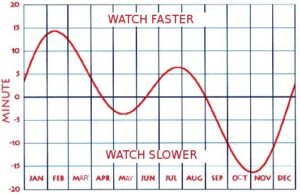 Clocks measure the length of a day averaged over a full year – the Sun’s average motion across the sky. Sundials show the Sun’s true motion. Over the course of a year, the length of a solar day – the period from one local noon to the next – varies by almost a minute. And that adds up. In early February, a solar day lasts about 14 minutes less than 24 hours. In early November, it lasts about 16 and a half minutes more than 24 hours.
The change has a couple of causes. Earth’s orbit is lopsided, so our planet travels at different speeds. When we’re closest to the Sun, we move faster than average; when we’re farthest, we move slower. But the rate at which Earth spins on its axis remains the same. The difference in those two motions causes the Sun to move a little faster or slower across the sky, changing the length of a solar day.
And Earth’s axis is tilted, so the poles take turns dipping toward the Sun. Today is the June solstice, so the north pole is tilting sunward. The change in the Sun’s position as a result of that tilt adds to the complexity.
The solar day is exactly 24 hours long around June 13th. So now, the equation of time is almost zero – a close match between the sundial and the clock.
Script by Damond Benningfield